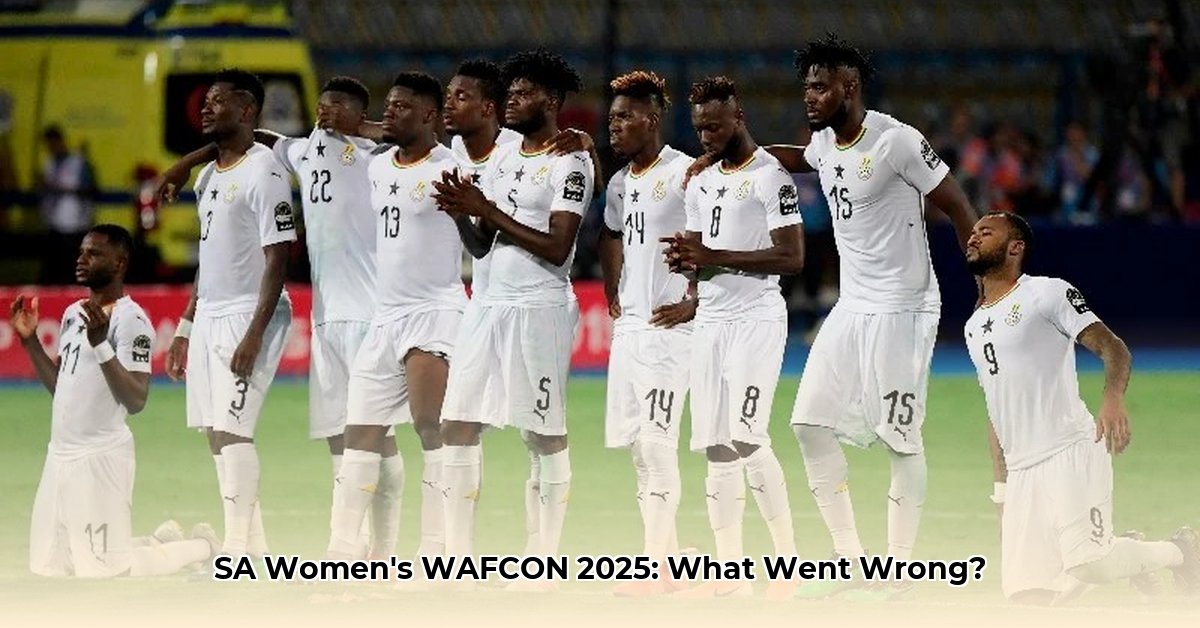
South Africa's Disappointing WAFCON 2025 Campaign: A Performance Review
Banyana Banyana's early exit from the WAFCON 2025 tournament was a significant disappointment, raising serious questions about the team's preparedness and overall strategy. This review analyses the key factors contributing to their underperformance, offering actionable recommendations for future success. The underwhelming results, particularly the struggles against seemingly weaker opponents and the crucial Ghana match, highlighted several systemic weaknesses requiring immediate attention. This isn't about assigning blame, but about identifying areas for improvement to ensure Banyana Banyana reclaims its position as a leading force in African women's football.
A Critical Look at Banyana Banyana's Performance
The group stage showcased a concerning lack of consistency. Draws against teams like Tanzania, even with the opposition playing a player down, exposed a crucial deficiency: a lack of that decisive edge needed to dominate weaker opponents. This inconsistency was not a one-off occurrence; it represents a persistent issue demanding immediate resolution. "The team lacked the killer instinct," commented Dr. Nomusa Buthelezi, Sports Psychologist at the University of Pretoria. "They struggled to convert possession into goals, even against less formidable opponents," she added. This suggests deeper issues beyond individual player performance.
Wasn't the problem simply a lack of fitness? While fitness is undeniably a vital component, the subpar performances even against less physically demanding opponents suggests otherwise. The issue appears more complex, potentially rooted in tactical inflexibility and suboptimal squad depth. "Our data shows a clear drop in decision-making quality in the final third," explained Mr. Sipho Mthembu, Head of Data Analytics at SAFA. "This wasn't a matter of poor finishing, but rather a systemic issue in creating high-quality chances."
The Ghana match, in particular, offered a stark illustration of these weaknesses. Could a deeper tactical analysis of previous encounters with Ghana reveal patterns to be improved upon? The coaching staff needs to seriously re-evaluate their strategies, including in-game substitutions. Did tactical changes provide the desired effect or disrupt the team's rhythm? These are crucial questions requiring immediate answers.
Key Areas for Improvement: A Roadmap to Success
The following numbered steps offer a practical framework for enhancing Banyana Banyana's performance:
Data-Driven Analysis & Investment: Comprehensive post-tournament analysis, utilizing advanced performance tracking technology, is crucial. This data-driven approach will pinpoint individual and team weaknesses, informing tailored training programmes. Investing in data analytics should be a top priority.
Enhanced Tactical Flexibility: Developing multiple tactical approaches, and the ability to adapt strategies mid-match, is paramount. This requires dedicated training focusing on transition play between attack and defence, as well as drills improving decision-making in the final third.
Strengthening Squad Depth: Investing in youth development programs is essential to build a larger pool of skilled players. Identifying and nurturing talent at a younger age will produce a team less reliant on a small group of stars and provide valuable experience which will provide effective tactical flexibility.
Improved Pressing Efficiency: Implement systematic training to enhance coordinated pressing, focusing on quicker transitions between attacking and defensive phases of play. This requires detailed analysis to see what is working and why. This requires detailed analysis to determine what aspects of the team's pressing strategy are working well and what needs improvement.
Upskilling the Coaching Staff: Continuing professional development for the coaching staff is vital, focusing on tactical adaptability, player psychology, and data-driven decision-making. This should include specialized courses in modern coaching methodologies, including innovative training techniques and strategic analysis tools.
Conclusion: A Chance for Redemption
Banyana Banyana's performance at WAFCON 2025 was a setback, but also a valuable learning experience. By implementing the recommendations outlined, South Africa can build a stronger, more resilient, and ultimately, more successful national women's football team. The path to regaining dominance demands a commitment to data-driven analysis, strategic investment in youth development, and continued upskilling of the coaching staff. The future of Banyana Banyana depends on it. Only through a frank and honest assessment, combined with concrete and well-researched strategies, can we truly enhance the team's capability. The Ghana match in particular serves as a rich source of lessons to be learned.